
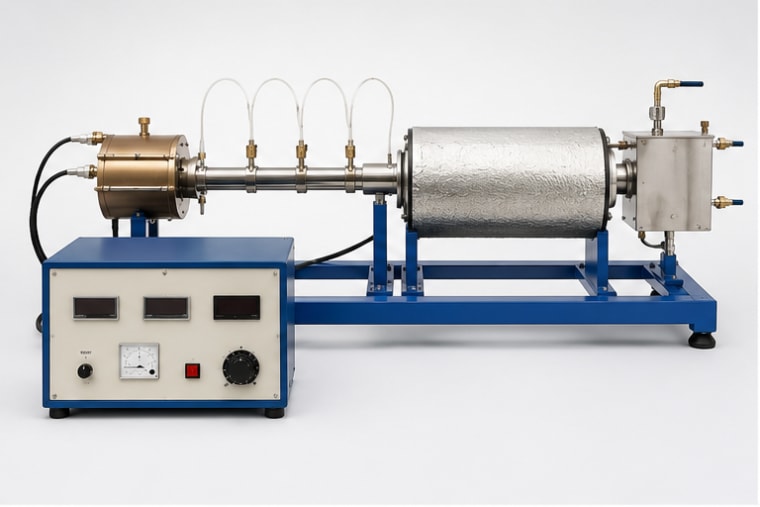
Overview
The Thermal Conductivity of Metal Rod apparatus determines the thermal conductivity of solid metal specimens through steady-state one-dimensional heat conduction along a rod. One end of the rod is heated electrically while the other end is water-cooled, and thermocouples measure the temperature distribution along its length. Students apply Fourier's law of heat conduction to calculate thermal conductivity from the measured temperature gradient and known cross-sectional area and heat flux. The experiment allows comparison of conductivities of different metals such as copper, aluminium, brass, and steel.
Specifications
| Rod materials | copper |
| aluminium | |
| brass | |
| mild steel | |
| Rod diameter | 25 mm (approx.) |
| Rod length | 400 to 600 mm |
| Heater | electric cartridge heater |
| 200W | |
| Cooling | water cooled end section |
| Temperature sensors | thermocouples |
| 5 to 8 axial positions | |
| Temperature range | ambient to 150 degrees C |
| Power supply | 220V AC |
| 50 Hz | |